
You built something genuinely complex. You can explain the architecture to a CTO in under three minutes. But the moment a CFO asks "why should I sign this PO?", the room goes quiet. This is the gap that kills B2B tech deals: a technical founder with clear vision who cannot translate that vision into a commercial case for every stakeholder on the buying committee. Your positioning was built for one audience, and enterprise deals require three to six. A multi-stakeholder positioning canvas for B2B tech companies solves this by producing distinct, connected messaging layers for each buyer role. This article breaks down the framework, names the most common positioning mistake, and shows you where to start this week. B2B buying decisions are driven by perceived improvements in business growth, profitability, and cost reduction, not by technical specifications alone. If your positioning doesn't speak to those priorities, you're losing deals you should be winning.
Standard positioning advice says: find your ICP, write one value proposition, and go to market. That advice collapses when your buyer committee has four to six roles with conflicting evaluation criteria. A multi-stakeholder positioning canvas for B2B addresses this directly because enterprise purchasing involves domain translation requirements that single-statement positioning cannot handle. Product positioning for enterprise buyers must account for the CTO evaluating architecture, the end user evaluating workflow, and the CFO evaluating cost impact, all simultaneously. Technical credibility constraints make this harder for B2B tech: your positioning must pass engineering scrutiny without losing commercial clarity for the economic buyer.
The founder who built the product is often the worst person to write positioning for non-technical stakeholders. They default to explaining how the product works, not why it matters financially. That's a structural problem that requires a structured framework to fix.
The Multi-Stakeholder Positioning Canvas produces a complete, role-specific messaging system for companies selling into enterprise buying committees with three or more stakeholders. It has four components because enterprise deals stall at four distinct points: clarity, relevance, differentiation, and credibility.
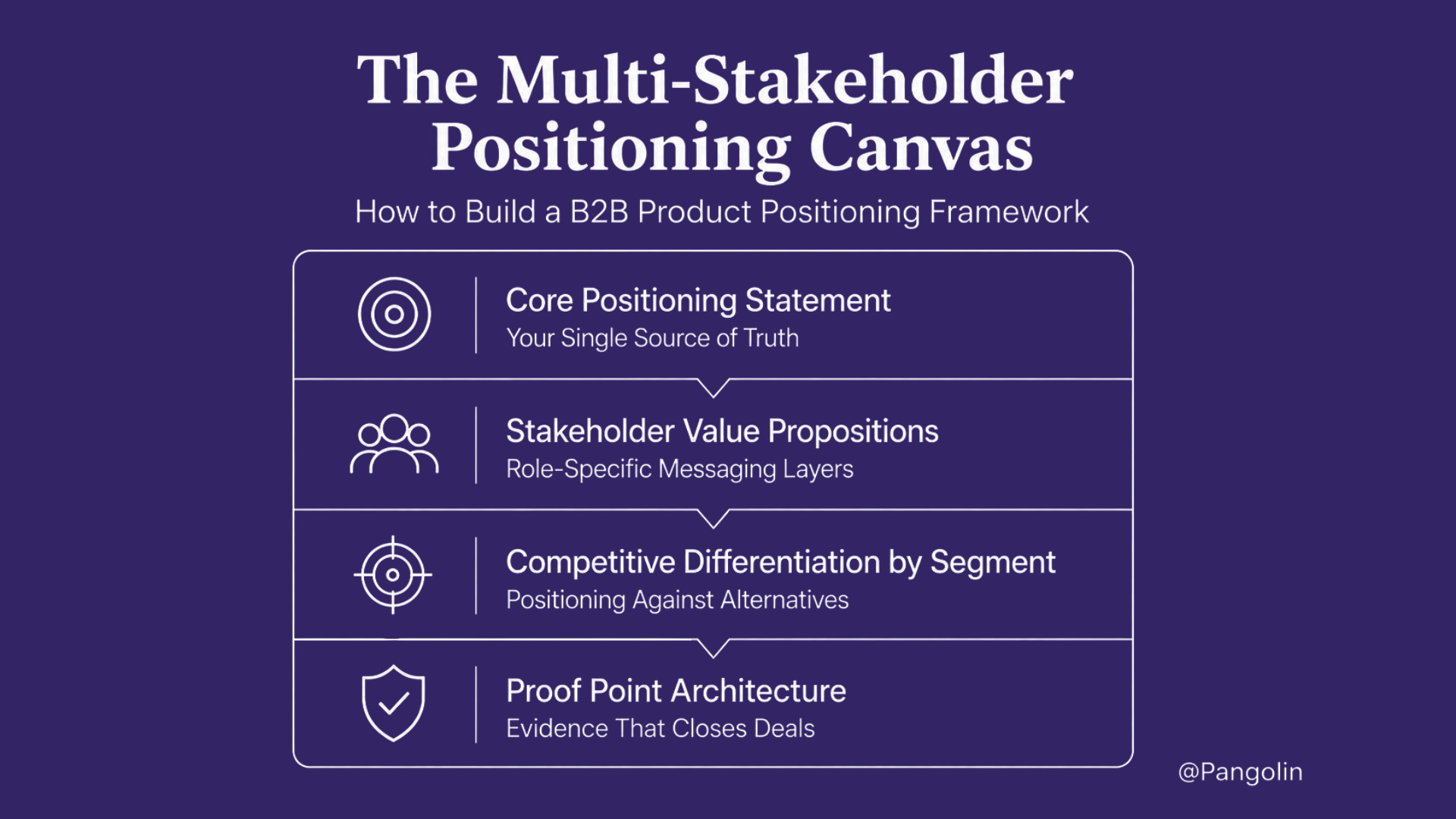
The core positioning statement is a 25-word maximum sentence defining what your product does, for whom, and why it matters. For a B2B supply chain visibility platform, this might read: "Real-time freight intelligence that eliminates manual tracking for logistics teams managing 500+ shipments monthly."
Stakeholder value propositions translate your core statement into the language each buyer role uses to evaluate purchases. A product positioning framework for enterprise buyers might produce three layers: "reduces manual reconciliation by 14 hours per week" for the user, "consolidates three vendor contracts" for the CFO.
This component maps your differentiation against the specific alternatives each buyer segment considers. A B2B SaaS positioning framework guide would show how your product beats spreadsheets for the end user and beats incumbent vendors for the procurement lead.
Proof point architecture organizes your case studies, metrics, and third-party validation by stakeholder role and buying stage. For a B2B tech company, this means mapping your SOC 2 compliance to the CISO's checklist and your ROI data to the CFO's approval criteria.
When all four components are in place, you have a B2B product positioning framework that equips every person on the buying committee with a reason to say yes.
The most common mistake is creating a single positioning statement that attempts to serve all buyers and satisfies none. Technically strong companies make this error because the founding team thinks in product terms, not buyer terms. The commercial consequence is predictable: your internal champion loves the product, but the deal dies at CFO review. The correction is building distinct value propositions per stakeholder role using a structured framework like the Multi-Stakeholder Positioning Canvas.
Product positioning for enterprise buyers requires you to say different things to different people without contradicting yourself. A B2B SaaS positioning framework guide gives you the scaffolding to do this consistently. In practice, this looks like three versions of your one-pager: one for the technical evaluator, one for the operational champion, and one for the economic buyer.
Each version shares the same core claim. Each version proves that claim using different evidence. That's the difference between positioning that wins champions and positioning that closes deals.
IntelliTrans, a supply chain intelligence company entering enterprise evaluations with Tata Motors-scale buyers, needed a multi-stakeholder positioning canvas for B2B that could pass both technical and commercial scrutiny simultaneously. Pangolin built the complete framework in four weeks: core positioning statement, three stakeholder value propositions, competitive differentiation maps, and a proof point architecture scoped for product positioning for enterprise buyers.
The outcome was a complete positioning framework built in four weeks for Tata Motors-scale enterprise evaluation. The three-layer messaging architecture served user, champion, and economic buyer simultaneously with zero accuracy corrections from the technical team. This is what a B2B SaaS positioning framework guide looks like when applied to a real company with real revenue pressure.
See the full IntelliTrans case study →
The zero-correction result matters. It means the positioning was technically accurate enough for the engineering team and commercially clear enough for the CFO. That dual standard is the benchmark for any B2B tech company selling into enterprise committees.
Build the multi-stakeholder positioning canvas in-house if you have a dedicated product marketing hire with enterprise positioning experience. You also need at least six weeks before your next enterprise evaluation or US market entry deadline.
A hybrid model works when your founding team owns the strategy and domain expertise. An external partner structures and writes the product positioning for enterprise buyers based on those inputs.
Bring in an external specialist when you have no product marketing hire, a confirmed US market entry, and enterprise deals stalling mid-funnel. Pangolin builds this B2B SaaS positioning framework as a four-week engagement scoped from strategy through final deliverables.
The choice depends on your timeline and internal capacity. Sprih, for example, used Pangolin's positioning work to fuel a $3M raise and US market launch. That's the kind of outcome possible when positioning is treated as commercial infrastructure, not a marketing exercise.
Map every role on your buyer committee and write down the one question each role asks before approving a purchase. This single action forces you to think in stakeholder terms instead of product terms. Once you have that map, you have the input layer for the Multi-Stakeholder Positioning Canvas, and the B2B SaaS positioning framework guide becomes immediately usable.
If you want Pangolin to build your B2B product positioning framework as a scoped engagement, the buyer committee map is where we start too.