
Your European sustainability platform has strong CSRD compliance features, and US CFOs aren't responding. Pipeline stalls every time your sales team sends a compliance-first business case across the Atlantic. This piece gives you the exact reframe: how to translate CSRD compliance communications for a US CFO buyer committee that evaluates on financial risk, not regulatory obligation. It's written for founders and marketing leads at EU-built ESG platforms entering the US market, building an enterprise business case for a buyer who has never heard of CSRD.
The core problem is positioning. The product already solves the US enterprise problem. The entry point into the buyer's evaluation criteria does not. The CSRD framework carries weight in Brussels and Berlin. In Chicago and Charlotte, it registers as someone else's regulation. Every week you spend selling compliance to a buyer who isn't compelled by compliance is a week your US competitors gain ground with the same CFO using risk and efficiency language. The ESG platform US market entry CFO business case requires a different vocabulary, a different proof structure, and a different entry point into the buyer's priorities.
Every European platform that succeeds in its home market builds positioning around the regulatory frameworks that drive procurement there. Product marketing teams in the EU naturally anchor messaging to CSRD because that's what their buyers care about. The gap becomes visible the moment the first US enterprise deal stalls at the CFO level. No one made an error: CSRD to US market positioning for a sustainability platform simply requires a different frame than the one that built your European revenue. EU sustainability platform US enterprise repositioning is a structural challenge that follows the same pattern at every platform that builds EU revenue before attempting a US enterprise motion.
The cost of leaving this unaddressed compounds fast. The CSRD applies to over 4,000 non-EU companies, many of them US-headquartered, but the US CFO at most of those companies doesn't know that yet. Your window to be the platform that educates and converts that buyer is narrow. Every quarter without repositioned messaging is a quarter where a US-native competitor frames the same capabilities in language the CFO already understands.
These attempts are rational. Every one of them makes sense from inside the company that tries it. They all share the same structural flaw: they assume the US CFO needs to understand CSRD before buying. That misdiagnosis is what makes each approach fail for EU sustainability platform US enterprise repositioning.
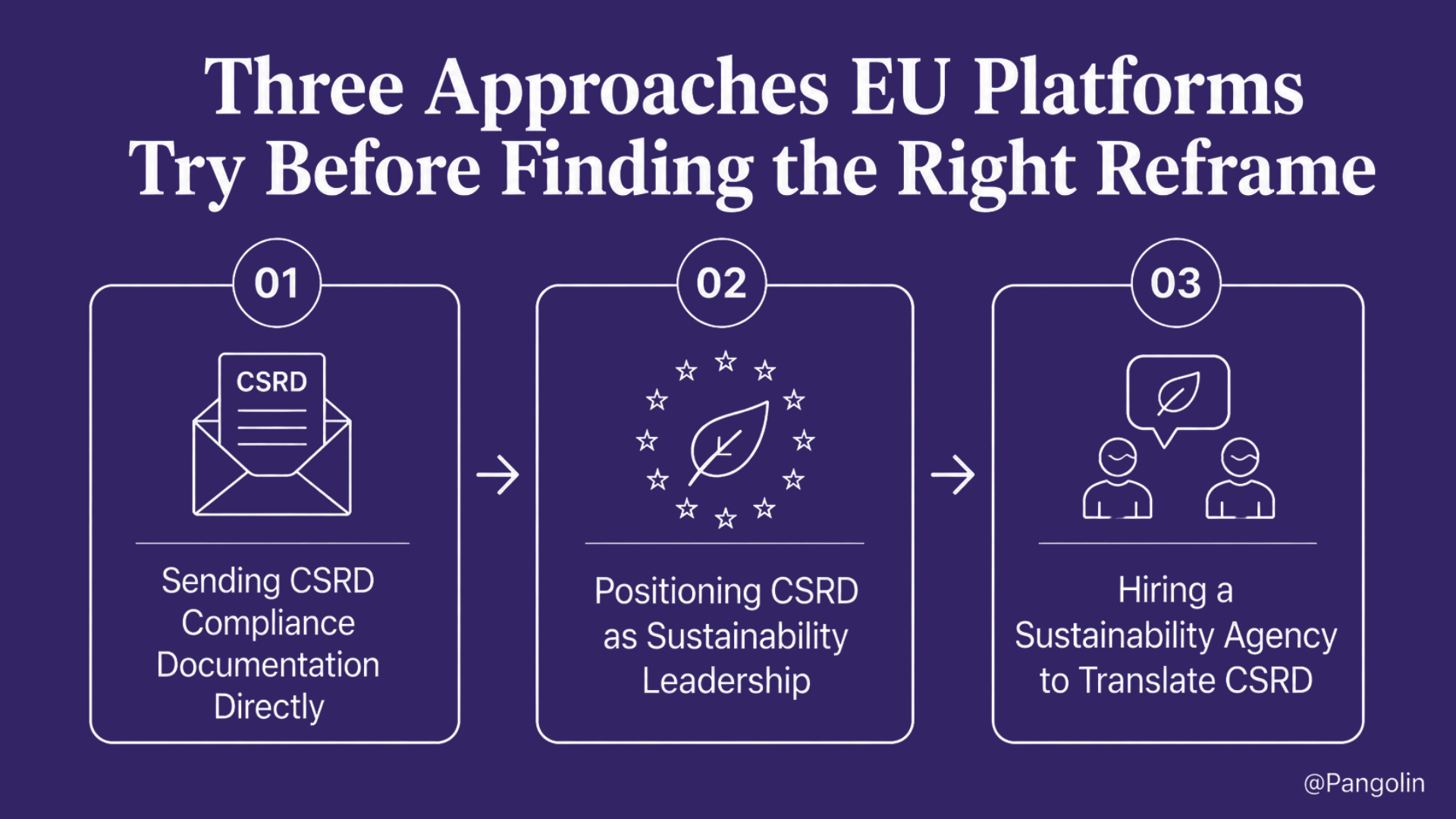
The team sent detailed CSRD compliance materials to the US CFO, who filed them with no reply. The CFO doesn't evaluate against European regulatory frameworks, so the document had no procurement trigger. The document had no procurement trigger for the buyer receiving it. Wrong audience, wrong frame: a content quality fix cannot address either.
The pitch framed CSRD readiness as a forward-thinking sustainability story, and the CFO routed it to the sustainability team. That team had no procurement authority and no budget. The CFO evaluates financial risk, not leadership narratives, making this a structural mismatch for EU sustainability platform US enterprise repositioning.
A sustainability communications agency produced accurate CSRD translations that explained the regulation clearly. The output was technically correct and commercially useless in a CFO business case. Regulatory translation and CSRD SEC climate disclosure translation for US buyers are two different disciplines with different outputs.
The central insight: stop selling compliance and start selling what compliance produces. US CFOs care about financial risk exposure, investor reporting readiness, and operational cost reduction. Smart companies miss this because their own experience with CSRD is regulatory: they built the product to meet a mandate, so they sell the mandate.
When you apply this reframe, the US CFO conversation changes from "why should I care about European regulation" to "this platform reduces my reporting costs and closes investor risk gaps." One specific example: instead of "CSRD-ready double materiality assessment," your US-facing pitch says "automated ESG data collection that cuts investor reporting prep time by 60%." Same capability. Different entry point. CSRD SEC climate disclosure translation for US buyers means mapping each feature to a financial outcome the CFO already tracks.
The SEC's proposed climate disclosure rules create a parallel US pressure that your platform already addresses. That pressure is the correct entry point for the US CFO conversation.
The solved state is specific and measurable: named roles take named actions that produce named commercial outcomes. You know the problem is solved when US enterprise deals advance past the CFO without a single slide explaining European regulation, and your CSRD to US market positioning for the sustainability platform generates pipeline on its own.
EU sustainability platform US enterprise repositioning doesn't mean hiding your European heritage. It means translating it into the commercial language each market's buyer committee uses to approve spend.
CarbonMinus, a European sustainability platform, entered the US market with strong CSRD compliance features and stalled at the enterprise CFO level. Their prior attempts included sustainability-focused messaging and CSRD explainer content, which produced low engagement and zero qualified enterprise pipeline. CSRD to US market positioning for their sustainability platform needed a complete reframe.
Pangolin built a sustainability-to-business-value positioning system connecting ESG compliance features to CFO financial risk language within a 60-day engagement. The repositioned messaging produced a 42% increase in qualified leads, including enterprise buyers who had previously deprioritized sustainability platform evaluation. EU sustainability platform US enterprise repositioning delivered measurable pipeline growth once the language matched the buyer.
42% - increase in qualified leads after repositioned messaging activation
60 days - from engagement start to measurable pipeline impact
Enterprise buyers re-engaged - previously deprioritized evaluations reactivated through financial risk framing
Read the full CarbonMinus story →
This pattern is repeatable. Sprih, another Pangolin engagement, used persona-driven positioning to fuel a $3M raise and US market launch. The underlying method is the same: translate what works in one market into the commercial language of the next.
Take your top five CSRD compliance features and write one sentence for each that describes the financial risk it mitigates for a US enterprise buyer. This single action is higher-priority than any other positioning work because it creates the raw material for every US-facing asset: pitch decks, one-pagers, website copy, and sales scripts. At the end of this exercise, you'll have a feature-to-risk translation table that your sales team can use in the next US CFO conversation. Each row connects a CSRD capability to a specific SEC climate disclosure requirement, investor ESG reporting expectation, or operational cost reduction. CSRD SEC climate disclosure translation for US buyers starts with this table.
If you want this built as a complete positioning system with sales enablement assets, Pangolin builds CSRD compliance communications reframes for EU platforms entering the US market.
The product that won European enterprise deals already solves US enterprise problems. The gap is entirely in positioning and messaging. US CFOs don't need to understand CSRD. They need to see how your platform reduces their financial risk, automates their investor reporting, and cuts their operational costs.
Build the translation table this week. Map each CSRD feature to its US financial equivalent. Test the new language in your next three US CFO conversations. Track whether deals advance past the first meeting. That's your signal.
If the pipeline moves, you've found the reframe. If it doesn't, the translation needs refinement. The structural insight holds regardless: compliance language converts in compliance markets, and financial risk language converts in financial risk markets. The structural insight holds: compliance language converts in compliance markets, and financial risk language converts in financial risk markets. Your platform serves both. Your positioning needs to serve both too.