
A single pricing tier is a trap. It looks simple. It feels efficient. But it bleeds revenue from both ends of your market. SMB buyers see a price tag built for a company three times their size. Enterprise procurement teams see a product that doesn't look serious enough to survive their security review, let alone their vendor assessment. You're stuck in a dead zone: too expensive for the small buyer, too informal for the large one.
This is the core tension a B2B SaaS pricing and packaging framework must resolve. The fix is restructuring your packaging around how different buyers actually purchase, evaluate, and justify software internally, not simply stacking more tiers onto an existing structure. The Value-Based Packaging Ladder is a four-component system designed to do exactly that. It maps your product's value to four distinct buying motions, from self-serve PLG through corporate procurement. Improving monetization has a 12.7% impact on the bottom line, significantly outperforming customer retention at 6.71% and customer acquisition at 3.32%. Pricing architecture is the single highest-return commercial decision a SaaS company can make between Series A and C.
What follows is the framework itself, the most common mistake companies make when applying it, a real application, and the decision of whether to build it yourself or bring in outside expertise.
Most SaaS pricing advice starts with competitor benchmarking and ends with three tiers on a pricing page. That works for horizontal tools selling to individual users. It breaks completely for B2B tech companies selling into multi-stakeholder committees with six-month procurement cycles.
Enterprise buyers don't just have bigger budgets. They require SOC 2 documentation, custom SLAs, and procurement-stage assets that justify the purchase to a CFO. A PLG pricing packaging enterprise tier strategy must account for this. Standard advice ignores domain translation requirements: the gap between what your product does and how an enterprise buyer committee describes the problem internally.
A value-based SaaS packaging strategy must address technical credibility constraints too. Enterprise evaluators assess whether your pricing structure signals maturity. A single tier with a "Contact Us" button for enterprise reads as an afterthought, not a serious offer. Most SaaS companies discover this only after losing three or four enterprise deals at the commercial terms stage, when the product passed technical review but the commercial package didn't survive procurement.
The Value-Based Packaging Ladder produces a pricing architecture matched to four distinct buyer motions, from self-serve individual users to procurement-led enterprise accounts. It has four components because B2B tech companies face four structurally different buying processes, each requiring its own PLG pricing packaging enterprise tier logic.
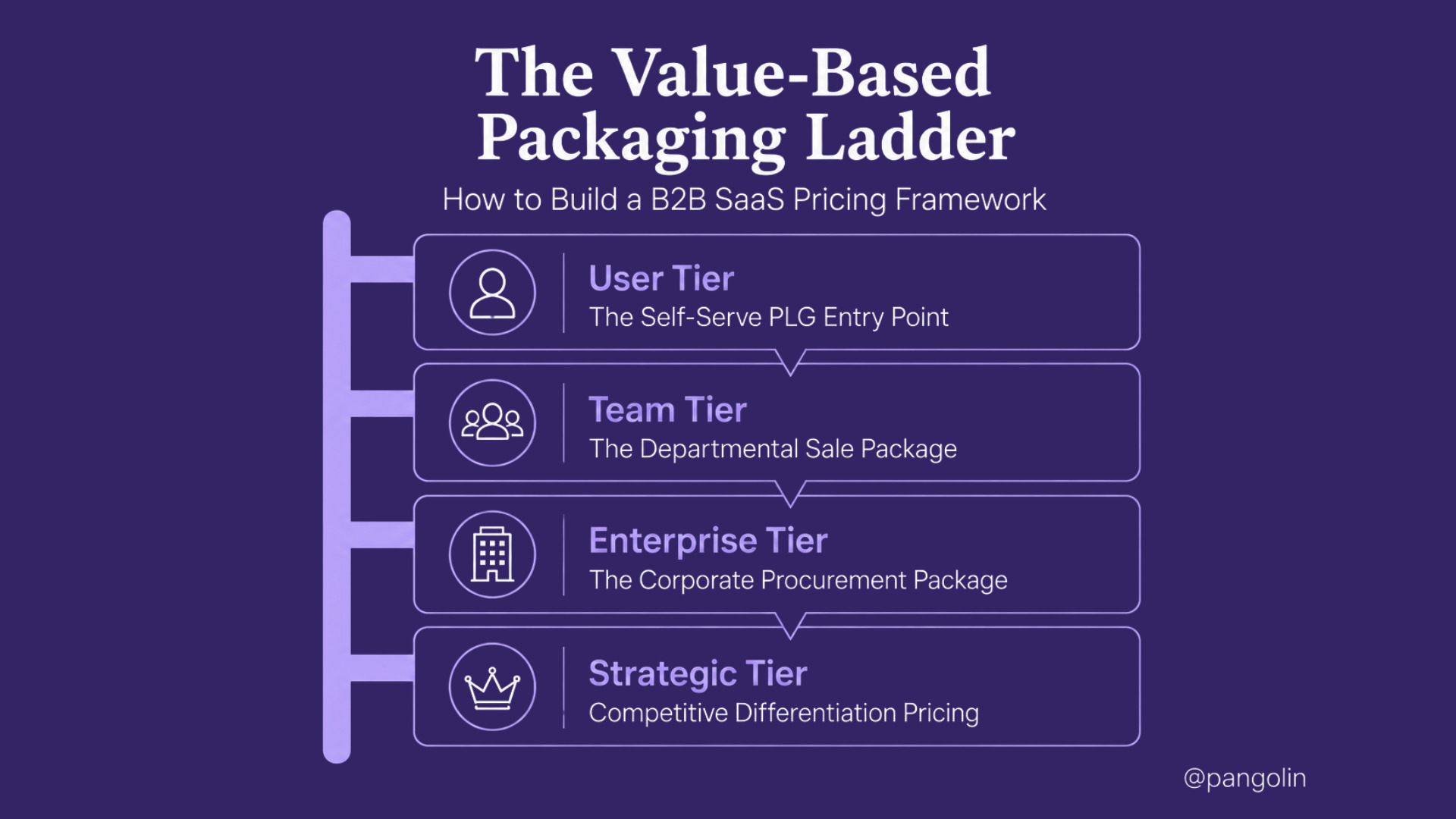
The user tier is a self-serve pricing motion designed to generate volume adoption with zero sales involvement. In practice, this looks like a B2B analytics tool offering a free or $29/month plan that a single data analyst can expense without approval.
The team tier is a packaged offer built for a department head making a purchase decision with a small budget. A cybersecurity SaaS company might price this at $200/seat/month, scoped for a 10-person security operations team with shared dashboards and admin controls.
The enterprise tier is a procurement-ready commercial package with custom SLAs, security documentation, and volume pricing. This tier includes everything a CISO or CTO needs to get approval: SOC 2 reports, data residency options, and dedicated onboarding within the SaaS pricing tiers from SMB to enterprise.
The strategic tier is a value-based SaaS packaging strategy designed to create switching costs and long-term platform lock-in. A compliance SaaS company might offer a strategic tier with custom API integrations, dedicated engineering hours, and co-developed features tied to the buyer's regulatory roadmap.
With all four components in place, a company has a complete B2B SaaS pricing and packaging framework that speaks credibly to every buyer type in its pipeline.
The mistake is packaging by feature count instead of packaging by buyer type. Technically strong companies make this error because they think about their product in terms of capabilities, not buying motions. Engineering-led teams naturally organize tiers by what the product can do, not by who is purchasing it or how.
The commercial consequence is severe. SMB buyers see features they don't need and assume they're overpaying. Enterprise buyers see a feature checklist and assume the vendor doesn't understand procurement. A value-based SaaS packaging strategy corrects this by organizing tiers around how each segment evaluates, purchases, and justifies software internally.
The correction is straightforward. Map your SaaS pricing tiers from SMB to enterprise against buyer roles, budget authority, and procurement process, not against feature access. In practice, this means your enterprise tier doesn't just unlock more features. It includes procurement-stage assets, custom SLAs, and a PLG pricing packaging enterprise tier that signals commercial maturity to a CFO reviewing the vendor shortlist.
SAHI was operating with a single commercial offer that failed to differentiate between self-serve users and enterprise procurement teams, stalling pipeline growth across both PLG pricing packaging enterprise tier and direct sales motions.
Pangolin built a value-based SaaS packaging strategy for SAHI that included buyer-segmented tier definitions, procurement-ready enterprise collateral, and repositioned pricing page architecture, delivered within a focused eight-week engagement.
The outcome was a multi-stakeholder value architecture built across five buyer segments simultaneously, enabling different value propositions at different commercial tiers without cannibalising the PLG adoption base. SAHI's targeted marketing strategy lowered CAC by 28% and lifted conversions 122%, demonstrating measurable commercial results across SaaS pricing tiers from SMB to enterprise.
See the full SAHI case study →
Build in-house if you have a dedicated PMM or product leader with prior SaaS pricing experience and at least eight weeks before your next enterprise pipeline review. You also need access to win/loss data from deals lost at the commercial terms stage, which is the raw material for any PLG pricing packaging enterprise tier redesign.
A hybrid model works when your in-house product team can model unit economics but lacks buyer-based packaging expertise. In this scenario, an external partner builds the value-based SaaS packaging strategy and enterprise tier positioning while your team owns the underlying cost structure and margin targets.
Bring in an external specialist if you have no pricing expertise on staff and you're losing enterprise deals at the commercial terms stage. Pangolin builds SaaS pricing tiers from SMB to enterprise as part of its positioning and revenue infrastructure work, particularly for companies entering the US market with pricing originally built for a different geography or buyer profile.
Pull your last ten enterprise deals that died at the commercial terms stage and categorize the objections. This single action reveals whether you're losing on price, on procurement readiness, or on perceived maturity, and each diagnosis leads to a different fix. That objection audit is the first input into a B2B SaaS pricing and packaging framework built on the Value-Based Packaging Ladder, and it gives you a SaaS pricing strategy enterprise guide grounded in your own pipeline data rather than generic benchmarks across SaaS pricing tiers from SMB to enterprise.
If you want a structured approach to this audit, Pangolin's B2B SaaS pricing and packaging work starts with exactly this analysis.
Your pricing page is the most visited asset in your sales process that you probably haven't redesigned since launch. A single tier worked when you had one buyer type. It stops working the moment you need both self-serve volume and enterprise contracts in the same pipeline.
The Value-Based Packaging Ladder gives you a structure for fixing this without guessing. Four tiers, each mapped to a real buying motion, each producing a different commercial conversation. The user tier feeds volume. The team tier captures departmental budgets. The enterprise tier survives procurement. The strategic tier builds long-term defensibility.
Sprih used a similar persona-driven approach to fuel a $3M raise and US market launch. The pricing and packaging work was part of a broader repositioning effort, not an isolated exercise. That's the point. Pricing isn't a standalone decision. It's the commercial expression of your positioning, your buyer understanding, and your go-to-market maturity.
Start with the deal audit. Categorize why you're losing. Build from there.

Aniket leads content marketing at Pangolin, writing and editing for B2B tech clients who need sharp messaging and consistent output. He came from journalism and brings that newsroom discipline to content work, turning drafts around quickly and keeping quality high.