
Your deck killed it in Sydney. Your US pipeline is dead quiet. The board approved US expansion six months ago, your first US sales hire starts next month, and every deal conversation stalls after the first meeting. This piece gives you the specific GTM strategy for moving an ANZ SaaS company into the US market when your existing materials produce confused responses from American buyers. It's written for Series A to C founders and heads of marketing at Australian or New Zealand SaaS companies with strong home-market traction who are now facing the commercial reality that a US go-to-market requires more than a currency conversion and a .com domain.
The ANZ SaaS market reached $10.66 billion in 2024, proving there's real substance behind companies that win in this region. But the commercial infrastructure that produced that traction was built for a specific buyer. Your US buyer doesn't know your reference customers. They don't recognise your compliance frameworks. They've never heard of the awards you won. That's a structural gap between what your materials prove and what a US procurement committee needs to see before they'll take a second meeting.
Every ANZ SaaS company that grows past $5M ARR domestically builds its GTM materials around local proof. The marketing team that built those materials did exactly the right thing for the ANZ market. The gap becomes visible the moment a US enterprise prospect receives your deck and asks a question your materials can't answer. No amount of advance planning prevents this because the trust signals US buyers require simply don't exist until you build them in-market. Each quarter without US-specific trust signals costs pipeline velocity that compounds against your runway.
ANZ SaaS expansion trust signals are different from ANZ trust signals. An Australian SaaS company pursuing US enterprise repositioning needs to understand that US buyers evaluate vendors on reference customer geography, timezone coverage for support SLAs, and familiarity with US regulatory environments like SOC 2 Type II, HIPAA, or FedRAMP. Your ISO 27001 certification matters, but it's table stakes, not a differentiator. Your customer logos from Melbourne don't reduce perceived risk for a procurement committee in Chicago.
These are rational responses to the problem. They aren't failures of execution. They share a common misdiagnosis: the US market gap is a structural trust architecture problem, and surface-level content fixes cannot close it..
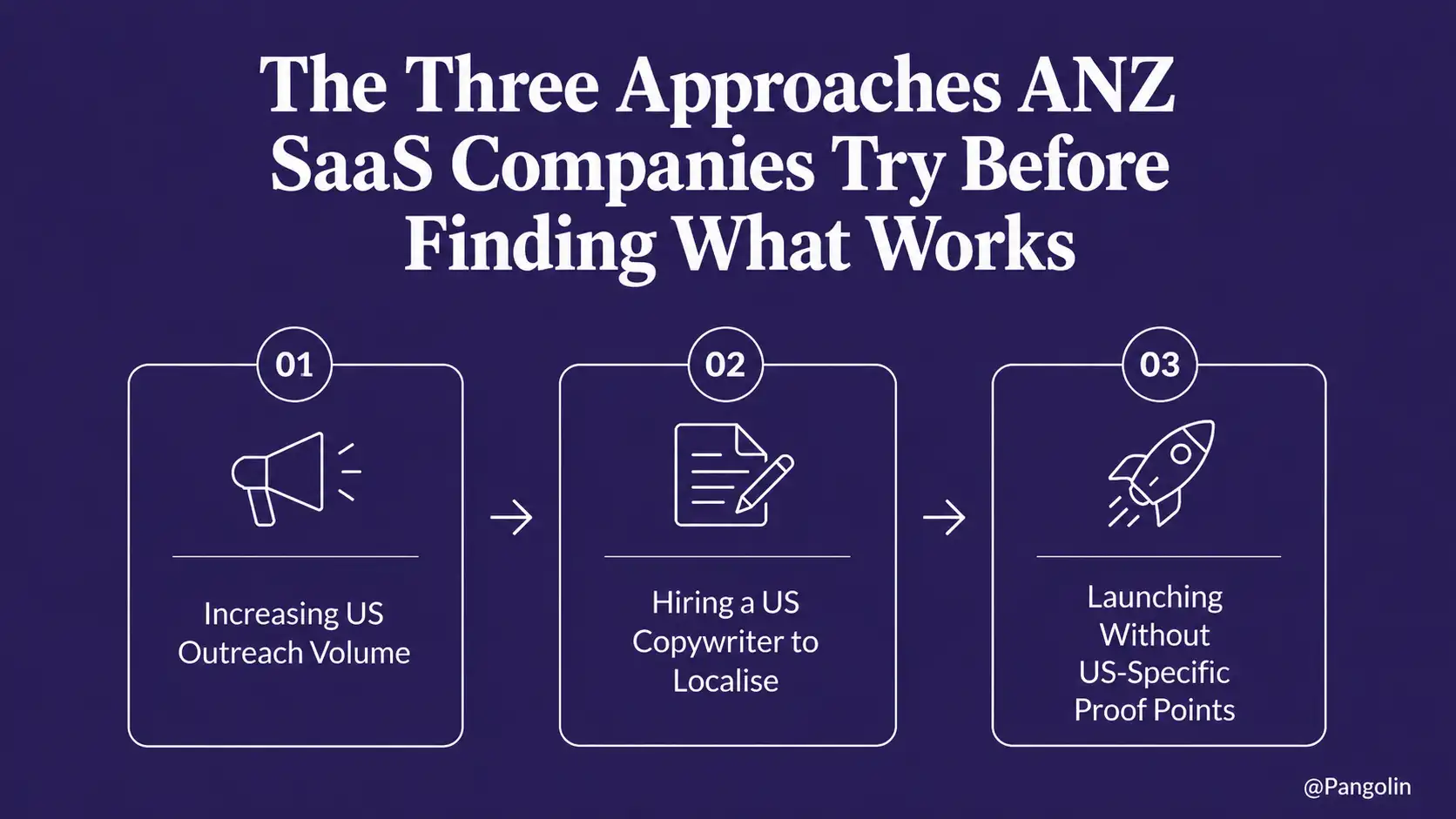
Teams sent ANZ sales materials to US prospects and responded to low reply rates by adding more volume. The positioning mismatch means more volume just scales the confusion: a channel fix addresses distribution volume, and the trust signal deficit sits one layer deeper.
Companies hired American writers who produced grammatically correct US English with commercially ANZ structure. A US-fluent copywriter without ANZ SaaS expansion trust signal expertise creates polished content that still fails the buyer's evaluation criteria.
Some companies entered the US market before building local reference customers, and enterprise buyers immediately asked for US case studies. An ANZ to US B2B product marketing agency would flag this gap before launch, but most companies discover it in a live deal they can't close.
The core insight for any ANZ to US SaaS GTM strategy is this: the transition isn't a localisation problem. It's a trust architecture problem. Companies miss this because their product genuinely works and their ANZ customers genuinely love it. Those facts feel like they should transfer. The buyer's evaluation framework operates on a different set of signals entirely.
When you rebuild your materials around US-specific trust signals, your conversion rate on first meetings changes within weeks. Here's what this looks like in practice: your case study stops leading with the customer's name and starts leading with the regulatory environment, the compliance requirement, and the business outcome denominated in a metric a US CFO recognises. The correct move is building a new deck that answers the questions a US procurement committee asks before they'll schedule a technical evaluation. Translation produces polished ANZ content. An ANZ to US B2B product marketing agency structures this as a trust architecture project. Copywriting is the final layer, applied after the architecture is built. Australian SaaS US enterprise repositioning means rebuilding the commercial logic of your materials from the buyer's evaluation criteria backward.
The solved state has named artefacts, named roles, and named commercial outcomes. You'll know the problem is solved when your US sales hire's first-meeting-to-second-meeting conversion rate matches or exceeds your ANZ baseline, because your ANZ SaaS expansion trust signals are now built into every touchpoint.
CarbonMinus came to Pangolin with strong product-market fit in their home market and zero traction with US enterprise buyers. They had tried localising existing materials and running US-targeted paid campaigns, producing grammatically American content that still failed ANZ SaaS expansion trust signal requirements for US procurement.
Pangolin built a complete Australian SaaS US enterprise repositioning programme within 60 days: new positioning, new sales enablement, new case study architecture, and a US-specific website experience. The result was a full market repositioning for US entry that produced measurable commercial outcomes across three key metrics.
42% increase in qualified leads within 60 days of US market activation
Accelerated enterprise buyer engagement with shorter sales cycles and higher first-meeting conversion
Increased investor inquiries driven by US-credible positioning and proof points
Read the full CarbonMinus story →
Take your strongest ANZ case study and send it to one US enterprise prospect today. This is higher-value than any other action because it generates a real-time map of every trust gap your US materials need to close. At the end of this exercise, you'll have a specific list of questions that represent the exact ANZ SaaS expansion trust signals missing from your current materials. Those questions become the brief for your US GTM rebuild, whether you do it internally or with an ANZ to US B2B product marketing agency.
Pangolin builds ANZ to US SaaS GTM strategy programmes scoped from positioning through sales enablement: see how we've done it for companies like yours.

Aniket leads content marketing at Pangolin, writing and editing for B2B tech clients who need sharp messaging and consistent output. He came from journalism and brings that newsroom discipline to content work, turning drafts around quickly and keeping quality high.