Marketing built detailed personas. Sales never opened the document. This is the single most expensive alignment failure in B2B tech companies, and it happens because traditional persona work answers the wrong question. Marketing asks "who is the buyer?" Sales needs to know "what is this person afraid of losing if they approve our deal?" That gap between demographic profiles and commercial fear is where pipeline stalls, deal cycles stretch, and win rates collapse. B2B buying decisions are driven by emotional factors in 80% of cases, even on million-dollar purchases. Yet most persona frameworks still lead with job title, company size, and LinkedIn behavior. The Commercial Fear-Based Persona Model exists to close this gap. It produces personas that sales reps actually reference before calls, because each one maps the specific commercial fear driving that buyer's evaluation criteria. This article lays out the full framework: four components, the most common mistake, a real application, and where to start this week.
Standard persona advice tells you to research demographics, goals, and pain points. That works for a single-buyer e-commerce purchase. It fails completely for enterprise B2B tech sales with multi-stakeholder procurement committees.
A six-person buying committee doesn't care about a persona slide with a stock photo and a fictional name. Each member evaluates your product through a different lens of risk. The CTO fears technical debt. The CFO fears cost overruns against board projections. The CISO fears a compliance gap that ends up in an audit finding.
A commercial fear buyer persona model captures these distinct anxieties and maps them to proof points. A demographic persona gives marketing a targeting tool. An enterprise buyer persona for sales team use gives reps the exact objection they'll face from each committee member, along with the evidence needed to neutralize it. That's the difference between a document that gets filed and one that gets used.
The commercial fear buyer persona model produces role-specific persona documents designed for multi-stakeholder enterprise procurement. Each persona equips a sales rep with the language, evidence, and objection map they need before a single call.
It has four components. Four is the minimum number required to connect a buyer's role to the proof they need before signing.
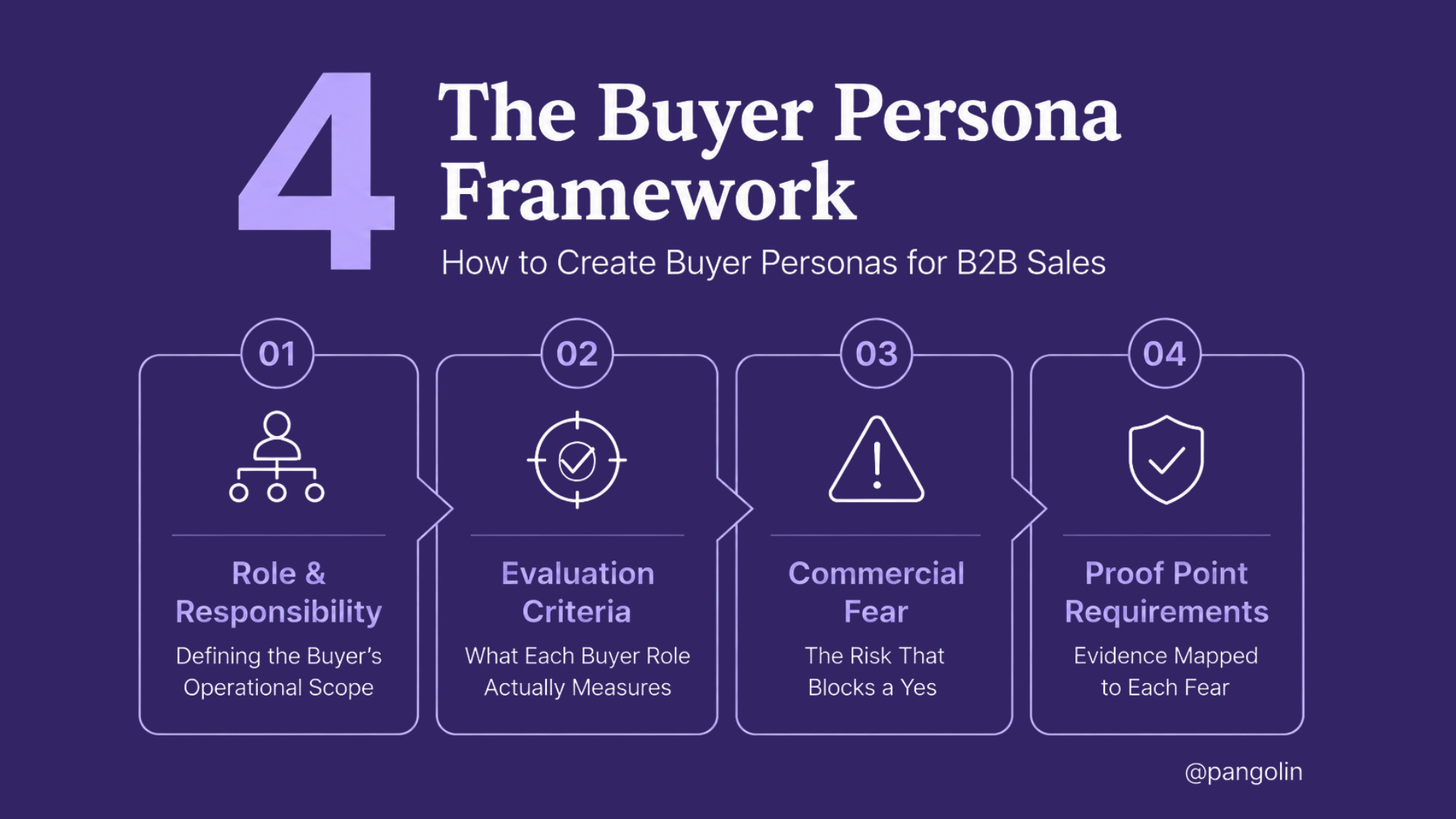
This component identifies the buyer's specific function and what they're accountable for delivering. For a B2B tech company selling to a VP of Engineering, this means naming their reporting line, budget authority, and the KPIs their bonus depends on.
Evaluation criteria define the specific metrics and standards each role uses to assess your product. A CISO evaluates against SOC 2 compliance and data residency requirements, not "ease of use" or "innovation." This is the foundation of any enterprise buyer persona for sales team deployment.
Commercial fear is the specific negative outcome the buyer believes they'll face if they approve the wrong vendor. A CFO's commercial fear might be a 15% budget overrun that triggers a board review. A CTO's fear might be an integration failure that delays a product launch by two quarters.
This component names the exact type of evidence each role needs to feel safe approving the deal. A B2B buying committee persona guide must specify whether a role needs a case study, a technical benchmark, a compliance certificate, or a reference call with a peer. For a CISO, that might be a SOC 2 Type II report and a penetration test summary.
When all four components are in place, you have a persona that tells sales exactly what to say, prove, and pre-empt for every buyer in the committee. That's how to create buyer personas that B2B sales teams actually use.
The mistake is building personas around demographics rather than commercial fear. It sounds obvious once stated. Most companies still do it.
Technically strong companies make this mistake because their marketing teams default to what's measurable: firmographics, job titles, and LinkedIn engagement data. These inputs are easy to collect and easy to present in a slide deck. They just don't help a sales rep handle the CFO's objection about implementation cost.
The commercial consequence is direct. Sales ignores the personas. Reps build their own informal buyer maps. Messaging fragments across the team. Win rates drop because there's no shared objection-handling framework.
The correction is to start every persona with the commercial fear, then work backward to role, evaluation criteria, and proof points. An enterprise buyer persona for sales team use starts with "what can go wrong for this person" and builds outward. A B2B buying committee persona guide that leads with demographics will collect dust. One that leads with fear will get pinned to a wall.
SAHI had five distinct buyer segments with different purchasing motivations and no unified persona framework connecting marketing spend to sales conversations. The commercial fear buyer persona model gave the team a structured way to isolate each segment's primary objection.
Pangolin built fear-based personas for each of SAHI's five buyer roles and delivered persona-matched messaging within a single quarter. Each enterprise buyer persona for sales team use included role-specific proof points and objection maps.
The outcome was measurable: commercial fear-based segmentation across five buyer roles produced a 122% increase in conversion rates and 28% CAC reduction through precision persona-matched messaging, documented in the B2B buying committee persona guide delivered to SAHI's revenue team.
See the full SAHI case study →
Build in-house if you have a product marketing hire with win/loss analysis experience and access to 10+ closed-won and closed-lost deals. You also need a VP Sales willing to contribute objection data from recent pipeline reviews. A commercial fear buyer persona model requires real deal data, not assumptions.
A hybrid works when your in-house team runs win/loss interviews but needs an external partner to structure the commercial fear model and proof point architecture. This is the most common fit for Series B companies with an enterprise buyer persona for sales team already partially built from founder-led sales.
Hire externally if you have no product marketing hire, are entering a new market with zero win/loss data, or are building personas for a buyer type you've never sold to. Pangolin builds B2B buying committee persona guides for companies entering US and ANZ markets from India, with proof points from engagements like CarbonMinus and Sprih.
Interview the decision-makers from your last five closed-lost deals this week. Those conversations contain the exact commercial fears your current personas are missing. Each interview will surface the objections, evaluation criteria, and proof gaps that the commercial fear buyer persona model is built to capture, giving you a B2B buying committee persona guide grounded in real deal data rather than assumptions.
Pangolin builds fear-based buyer personas for B2B tech companies: see how we approach it →
Most B2B persona work dies in a slide deck because it answers the wrong question. The Commercial Fear-Based Persona Model reframes the entire exercise around what sales needs: the specific fear each buying committee member carries into evaluation, and the specific proof that neutralizes it. Four components. Role, criteria, fear, proof. That's the complete structure.
Your closed-lost deals already contain every insight you need. The interviews are waiting. The objections are documented in your CRM notes and your reps' memories. The only missing piece is a structured model to organize that intelligence into something every rep can use before every call.
Sprih used persona-driven positioning to fuel a $3M raise and US market launch. SAHI cut CAC by 28%. These aren't abstract results. They're what happens when personas are built for the sales conversation, not the marketing presentation.
Start with five closed-lost interviews this week. Build from there.