
Your demo wins the room. Your champion goes silent two weeks later. The deal closes with the incumbent whose product everyone on the evaluation team called inferior. This is the defining commercial problem for Series B enterprise software companies with a superior product losing to incumbents with worse technology. The board wants answers. Your VP of Sales wants air cover. This piece gives you the specific enterprise software challenger positioning strategy that changes how procurement committees evaluate your category. It's written for founders and marketing leaders at growth-stage B2B companies watching winnable deals go to SAP, Oracle, or Workday quarter after quarter.
The pattern is structural, not personal. Every enterprise procurement committee optimizes for career safety first and business outcome second. This becomes visible the moment your deal moves from technical evaluation to commercial review. No amount of product excellence prevents it because the decision framework itself favors the known vendor. The commercial cost is measurable: you burn six to nine months of sales cycles per lost deal. Understanding how to compete against SAP, Oracle, and Workday enterprise software starts with accepting this reality. Beating incumbent enterprise software in B2B requires changing the evaluation framework before the incumbent sets it. Your enterprise software positioning against legacy vendors fails when you play their game on their terms.
Procurement committees at large organizations operate under risk-averse mandates that structurally favor vendors with longer track records. The committee member who signs off on SAP never gets fired. The one who signs off on your Series B company might. That asymmetry drives every deal you lose.
These attempts are rational responses to losing deals. They share a common flaw: each one accepts the incumbent's evaluation framework as the playing field. Enterprise software positioning against legacy vendors cannot succeed within a framework designed to protect incumbents.
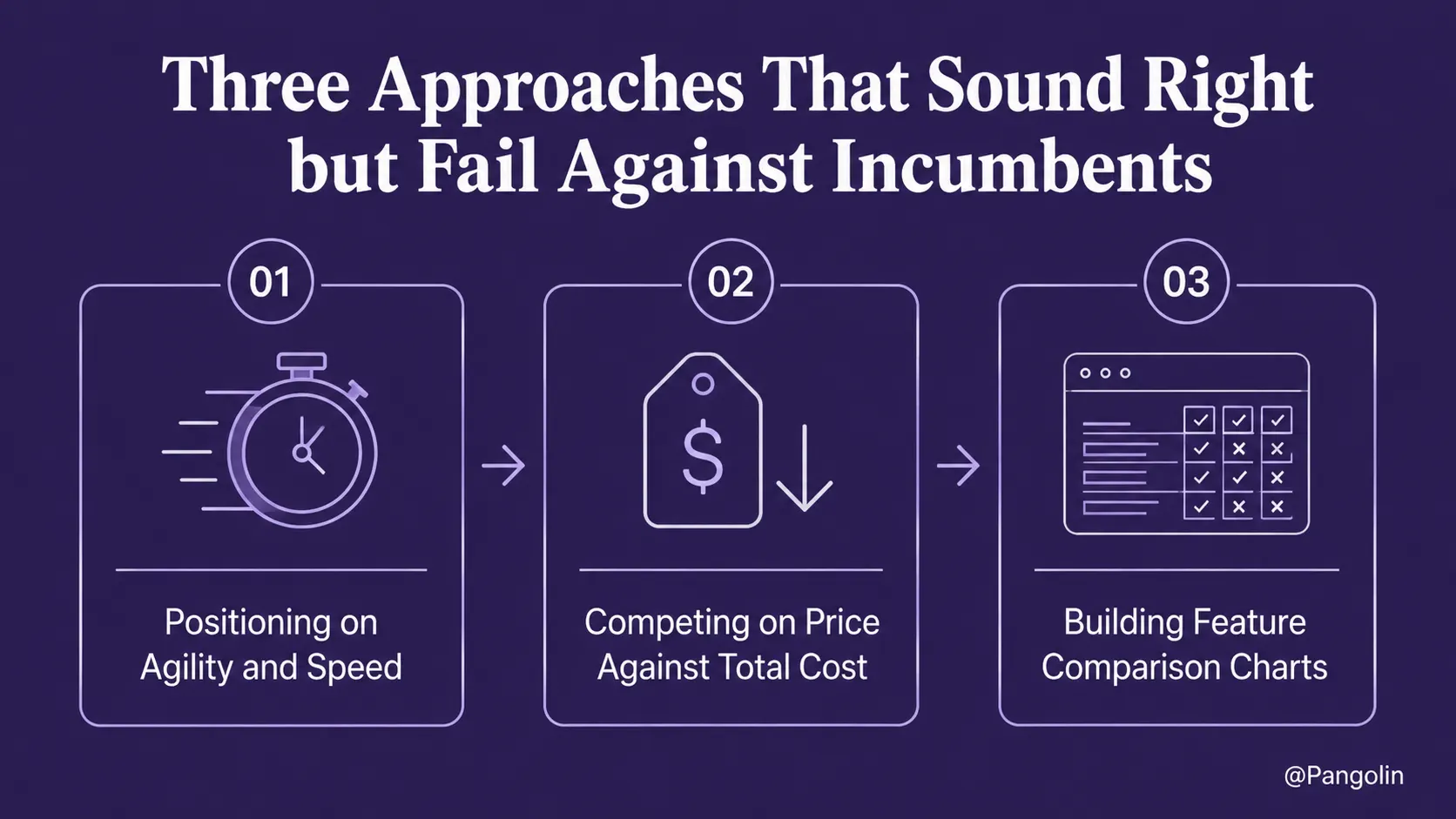
You pitched speed and flexibility against the incumbent's rigidity. Procurement countered with stability and risk mitigation, and the committee chose the known vendor. Agility is a feature claim. Enterprise procurement committees evaluate it as a risk signal, and risk signals favour the known vendor.
You offered a lower price point, and the incumbent won on total cost of ownership. Beating incumbent enterprise software in B2B requires reframing value because procurement teams evaluate lifetime cost including switching risk. A lower price point does not change the evaluation framework.
You built a detailed feature matrix showing technical superiority, and procurement still chose the known vendor. A Series B enterprise software win against incumbents requires answering the question procurement committees actually ask: what happens if you fail? Feature charts address capability. That question demands a risk narrative.
The pattern is consistent. AI companies captured over half of venture capital funding in 2025, proving investor confidence in challenger technology. Yet investor confidence doesn't translate to procurement confidence. That gap is where deals die.
The central insight: The shift is from proving you can deliver, to proving you can deliver for their specific use case. Companies miss this because they confuse product capability with procurement confidence. When you shift the evaluation criteria, the incumbent's scale becomes a liability, not an asset. A mid-market fintech doesn't need SAP's 47 modules. They need three workflows that work on day one. Stop sending generic capability decks immediately.
This is how to compete against SAP, Oracle, and Workday enterprise software at the evaluation stage. Enterprise software positioning against legacy vendors works when you make the buyer's specific context the primary filter. A Series B enterprise software win against incumbents happens when the procurement committee asks "who fits our situation best?" instead of "who is safest overall?"
The reframe looks like this in practice: instead of a 40-page RFP response covering every capability, you deliver a five-page business case showing exactly how your product solves their three highest-priority workflows with named timelines, named risks, and named mitigation steps. Enterprise procurement processes increasingly reward specificity over breadth because generic coverage creates generic results.
The solved state is concrete: named roles hold named artefacts that produce named commercial outcomes. Your win rate against incumbents rises from single digits to 25-35%, and your average sales cycle shortens by six to eight weeks. Beating incumbent enterprise software in B2B becomes a repeatable process, not a lucky break.
Each of these artefacts exists before the deal starts. They aren't improvised in the moment. A Series B enterprise software win against incumbents requires preparation that matches the incumbent's institutional muscle.
CarbonMinus faced the exact situation you're in: a technically superior enterprise sustainability platform losing evaluations to incumbents with longer track records and weaker products. They had tried feature-led positioning and price competition. Neither moved win rates.
Pangolin built a challenger positioning system and persona-driven website within 12 weeks. The engagement reframed CarbonMinus's evaluation criteria from compliance checkbox to business outcome, producing a 42% increase in qualified leads and accelerated US market entry against those same incumbents. Enterprise software positioning against legacy vendors worked because the evaluation framework changed before the incumbent could set it.
42% - increase in qualified leads after challenger positioning deployment
US market entry - accelerated timeline against incumbents with longer track records
Compliance to outcome - evaluation criteria reframed from checkbox to business result
Read the full CarbonMinus story →
This mirrors what Pangolin delivered for Sprih, where a persona-driven website fuelled a $3M raise and US market launch. The pattern repeats: reframe the evaluation, equip the sales team, and win deals that used to go to the incumbent by default.
Open a blank document right now. Write down the three most recent deals you lost to SAP, Oracle, or Workday. Write down the evaluation criteria reasons: the specific objections that killed each deal, not the feature gaps your product was measured against. This exercise takes 30 minutes and produces more commercial value than any positioning workshop. You'll have a challenger battle card brief, the exact input needed to build counter-narratives for every recurring objection. Beating incumbent enterprise software in B2B starts with naming the pattern your losses follow. A Series B enterprise software win against incumbents requires knowing exactly which evaluation criteria you keep losing on.
If you want those loss reasons turned into a full challenger positioning system, Pangolin builds enterprise software positioning programmes scoped to compete against SAP, Oracle, and Workday at the procurement stage.