
Your new US-based sales rep just lost the second enterprise deal this quarter. The prospect liked the technical proposal. They didn't trust the company behind it. This happens predictably when India-origin IT services firms hire US sales without rebuilding the trust signals US enterprise buyers require. The trust gap between India IT services companies and US enterprise buyers is a structural misalignment between how your company presents itself and how US procurement committees evaluate risk.
India's IT outsourcing sector is projected to constitute almost 60% of the world's IT outsourcing business by 2025, with roughly 59% of the global market. The capability is real. The trust architecture is missing. This piece gives you the specific framework for closing that gap: which objections to name, which materials to rebuild, and what actually moves enterprise procurement outcomes. It's written for founders and heads of marketing at India-based IT services companies between Series A and C who have US revenue targets and a sales hire who keeps hitting the same wall.
The trust gap between India IT services firms and US enterprise buyers follows a predictable growth pattern. Early revenue comes from referrals and small contracts where origin doesn't matter. The company builds delivery capability without building US-market positioning. Then a US sales hire arrives and discovers the collateral reads like a staffing agency brochure.
No amount of advance planning prevents this. The gap only becomes visible when the company enters competitive US enterprise evaluations. Every quarter this continues, the cost compounds: lost deals, longer sales cycles, lower win rates. Closing the India IT services trust gap within 90 days requires recognizing this as a repositioning from execution capability to strategic outcomes. Cosmetic adjustments do not change procurement evaluation outcomes. India offshore IT services strategic partner repositioning starts with accepting that the materials built for the home market structurally cannot serve the US enterprise buyer committee.
These attempts are rational responses to a real problem. They aren't bad decisions. Each one fails because it treats the trust gap as a perception issue. The actual deficit is structural: objections are going unanswered at the procurement stage. India offshore IT services strategic partner repositioning requires a different category of response entirely.
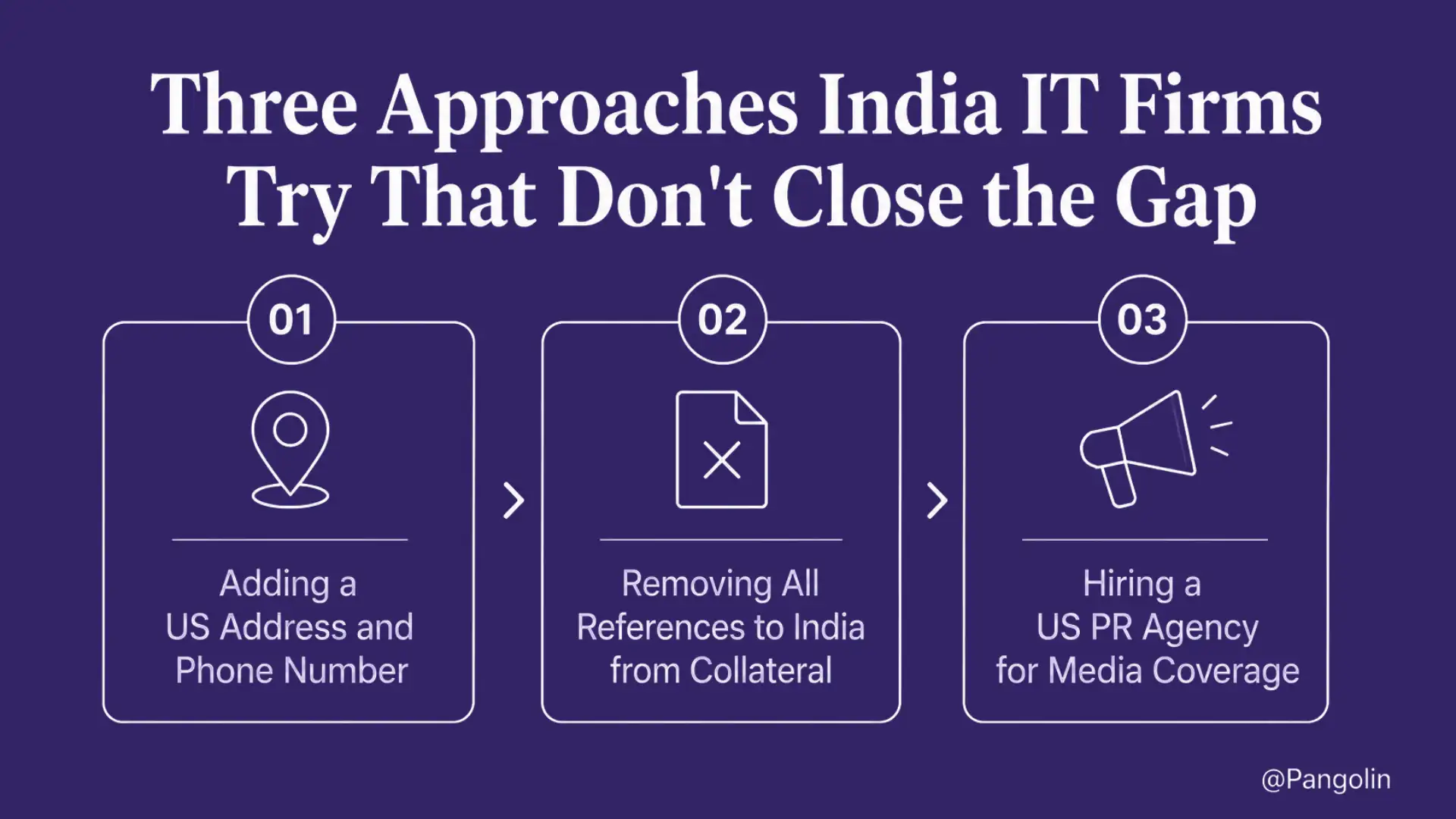
Companies added US office addresses and local phone numbers to their websites. US buyers still asked "where is your team actually based?" in the first meeting. US enterprise buyers probe delivery risk and timezone coverage directly. A local address sits upstream of those questions and leaves them unanswered.
Firms produced polished collateral that avoided any mention of India. Sophisticated enterprise buyers identified the origin within one search, and the evasion itself created distrust. Hiding origin signals that the company views its own geography as a liability. That's the opposite of closing the India IT services trust gap with US enterprise buyers within 90 days.
Companies hired US PR agencies and generated trade media coverage. Brand awareness increased with zero measurable effect on enterprise procurement outcomes. PR builds familiarity, not procurement-stage trust. India offshore IT services strategic partner repositioning requires objection-specific proof points, not general visibility.
The trust gap closes when your materials directly address four specific objections US enterprise buyers hold about India-origin IT partners. US enterprise buyers hold about India-origin IT partners: delivery risk, quality consistency, strategic capability, and timezone responsiveness. Companies miss this because the instinct is to minimize difference rather than address it head-on.
When you name these objections in your own collateral, something shifts. The buyer committee stops wondering whether you understand their concerns. They start evaluating your answers. One practical example: a case study that opens with "Our Pune delivery center maintains a 99.7% SLA compliance rate across 14 US enterprise accounts" does more than any US address ever could. The correct move is building an India IT company US enterprise credibility strategy that treats your origin as a proof point. Removal signals evasion to any buyer who runs due diligence. Companies that address objections explicitly in their collateral convert at higher rates than companies that pretend the objections don't exist.
The solved state is specific and measurable: named battle cards, named proof points, named responses to the three questions every US enterprise buyer asks. You'll know the problem is solved when your US sales hire stops improvising answers to origin-related objections and starts closing the India IT services trust gap with US enterprise buyers using pre-built assets.
CarbonMinus, an India-origin sustainability SaaS company, faced the exact situation described here. Their US-facing materials read as an offshore product team's output, not a strategic platform for enterprise buyers. Previous attempts at US-market collateral had produced no change in enterprise pipeline velocity. They needed to close the India IT services trust gap within 90 days.
Pangolin built a complete repositioning programme scoped from brand positioning through sales enablement within 60 days. The engagement produced persona-driven messaging, US-calibrated case studies, and procurement-stage collateral. CarbonMinus saw a 42% increase in qualified leads, accelerated US market entry timelines, and increased investor inquiries, all within 60 days of activating the repositioned messaging. This is India offshore IT services strategic partner repositioning in practice.
42% - increase in qualified leads after repositioned messaging went live
60 days - from engagement start to measurable US market traction
Increased investor inquiries - driven by credibility signals built for US buyer committees
Read the full CarbonMinus story →
Ask your US sales hire to write down the three India-origin objections they hear most often in US discovery calls. Do it today. It requires no preparation, no budget, and no approval. This single action is higher-leverage than any website redesign or PR programme because it tells you exactly where your materials fail.
At the end of this exercise, you'll have a specific list of objections your current collateral either ignores or handles poorly. That list becomes the brief for your India IT company US enterprise credibility strategy. If your materials don't address those objections by name, your collateral is producing the trust gap rather than closing it. You can close the India IT services trust gap within 90 days by starting here.
Pangolin builds this exact trust architecture for India-origin IT and SaaS companies entering the US market: see how we approach India-to-US repositioning.